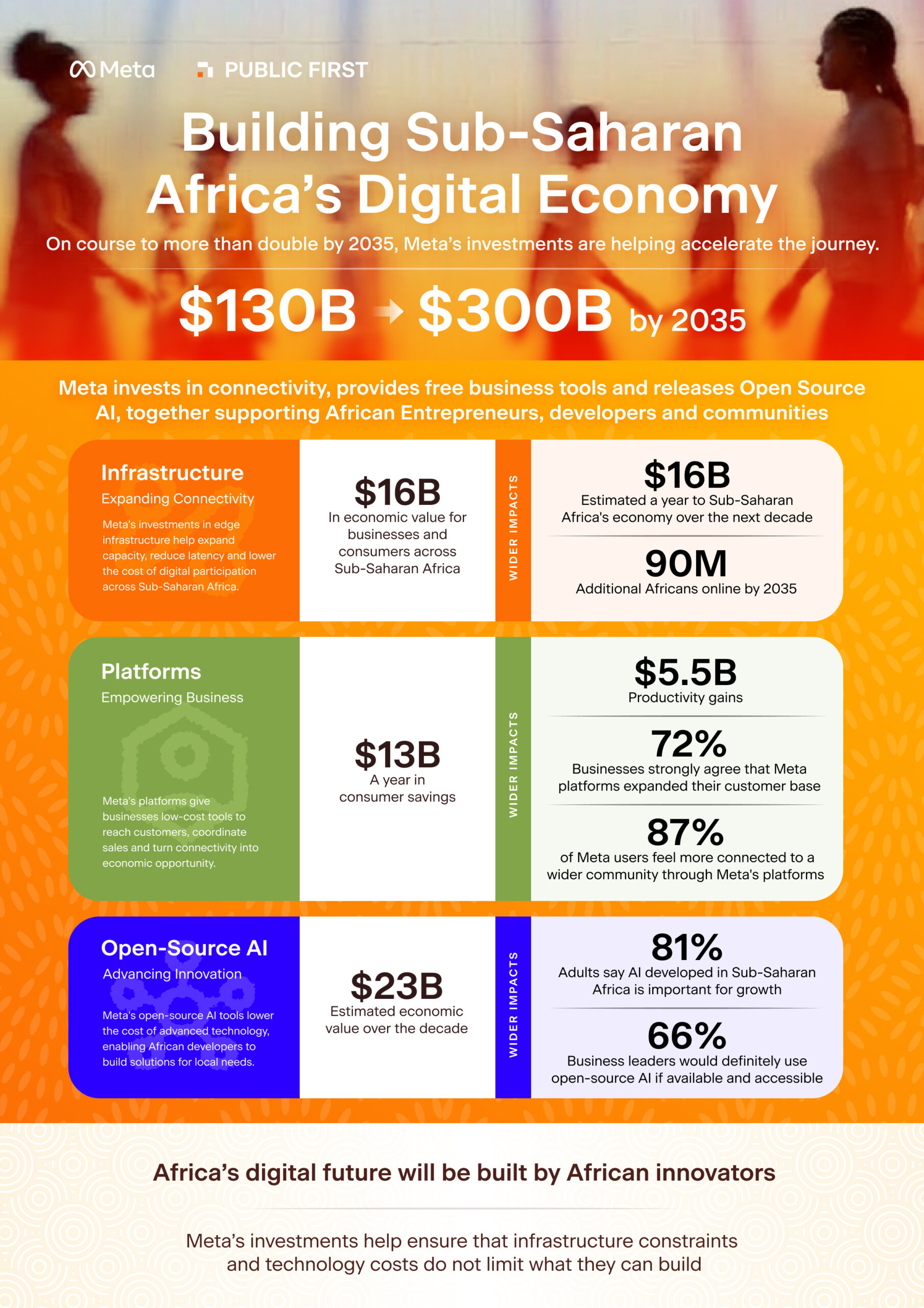
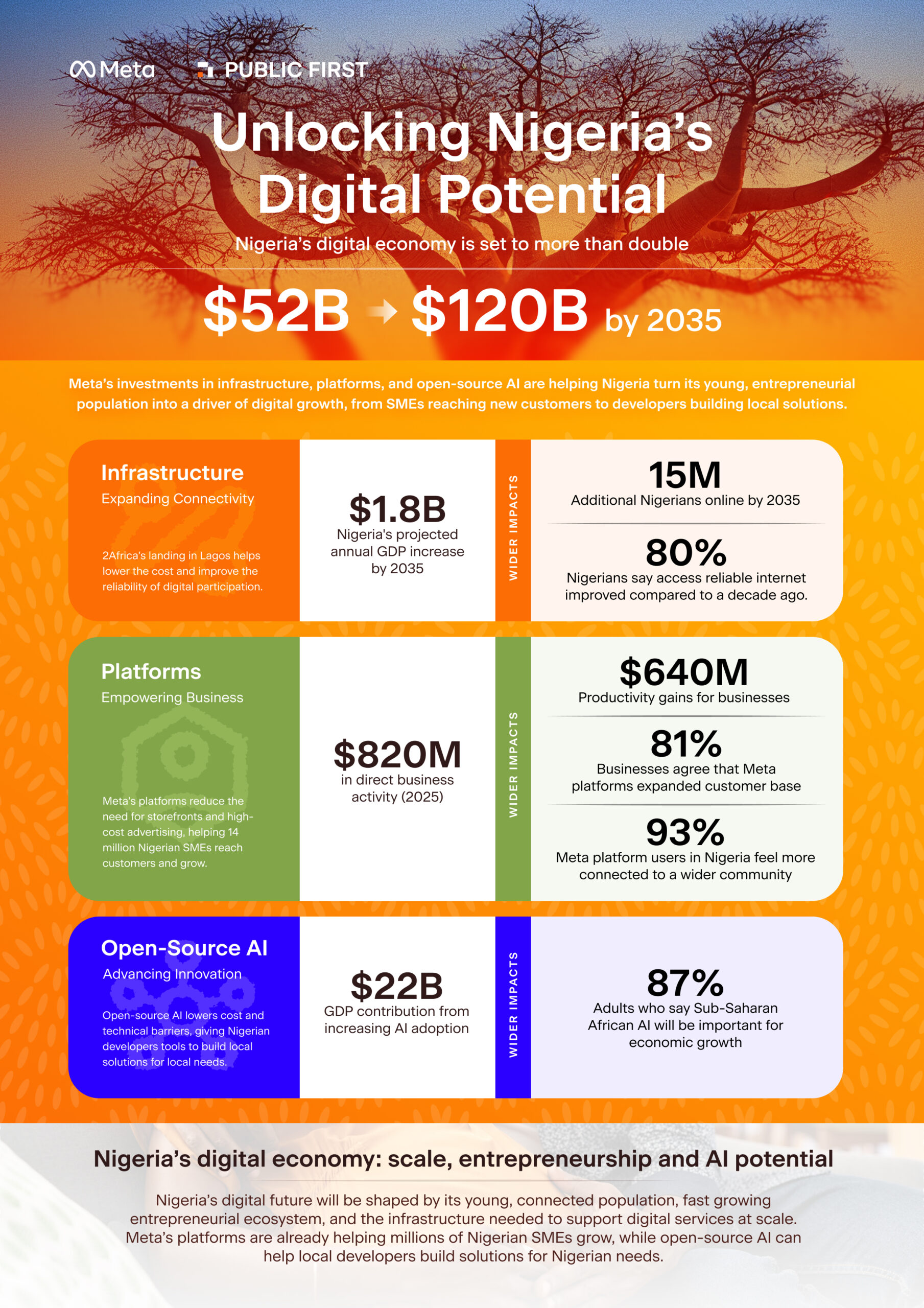
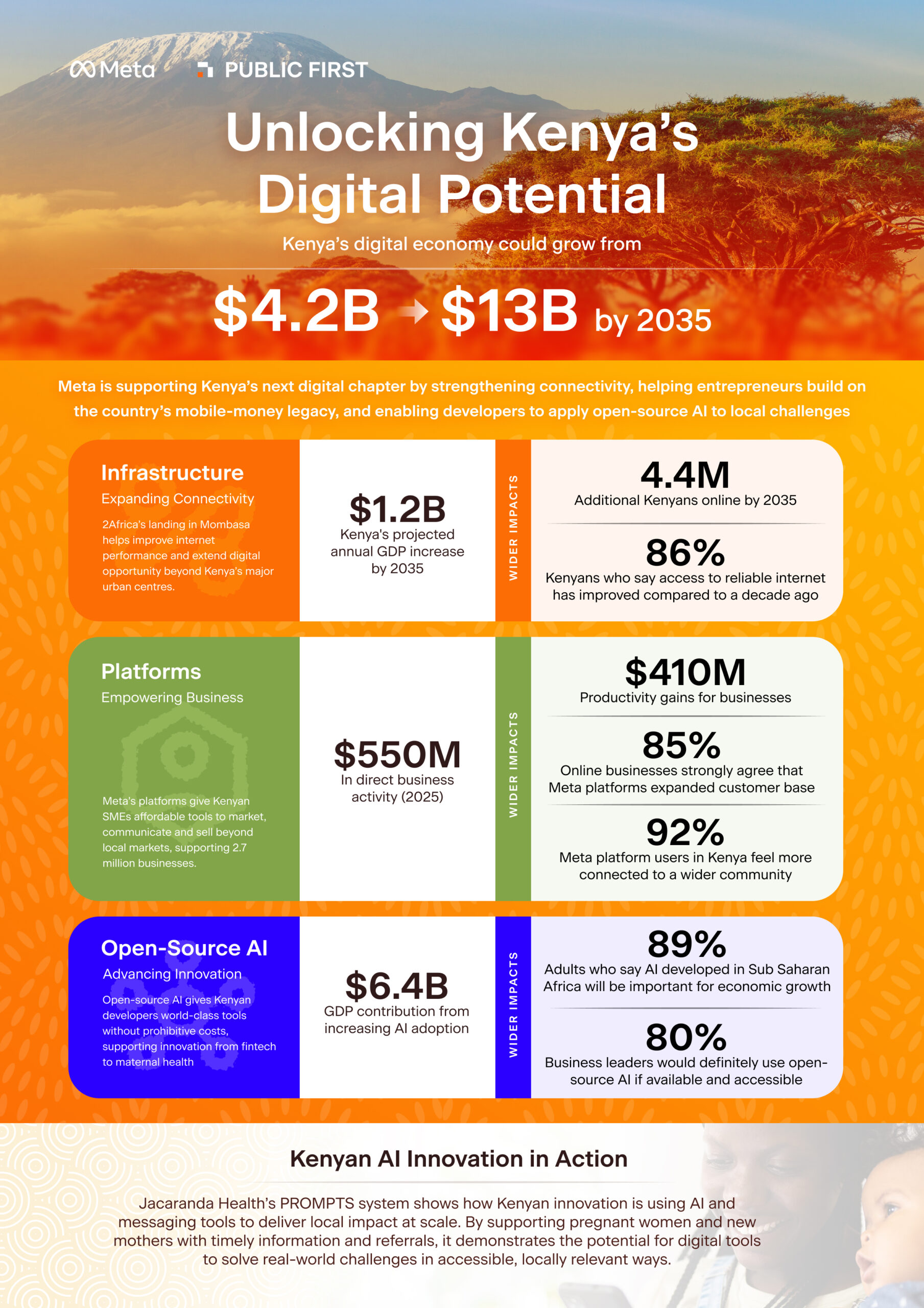
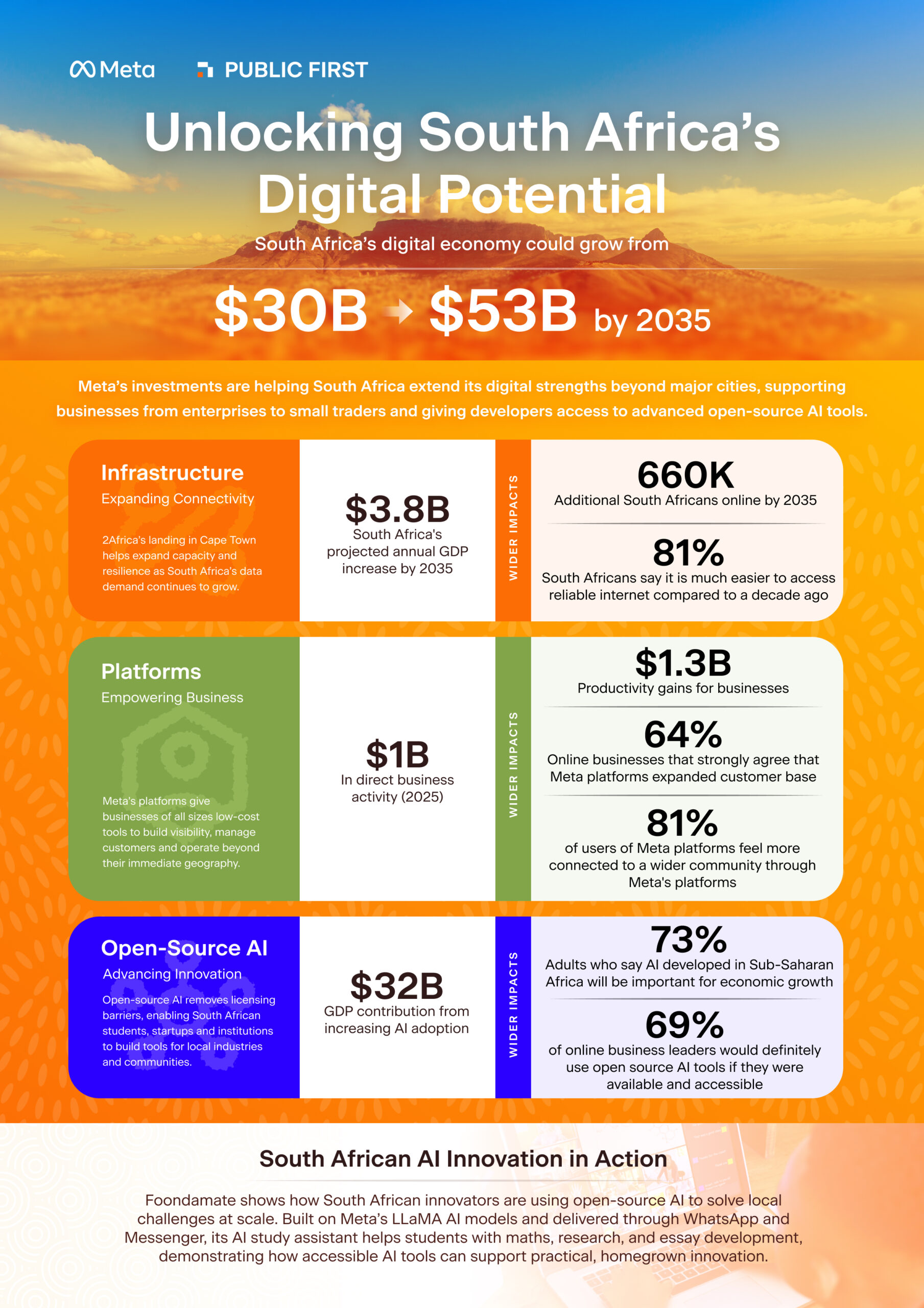
$13 billion in consumer savings as African households leveraged price transparency, expanded choice, and access to a broader range of sellers
May, 2026
View ContentsApril, 2026
Meta & SSA
Accelerating
Digital Transformation
Executive Summary
Executive Summary
Meta Supporting Sub-Saharan
Africa's Digital Transformation
Infrastructure
$16B
Annual economic value (2025)
2Africa and edge networks reduce latency and bandwidth costs, making advanced digital services viable at scale.
Wider Impacts
Capacity delivered
by 2Africa
180 Tbps
Additional Africans
online by 2035
online by 2035
90M
Platforms
$3.6B
In direct business activity (2025)
74M African SMEs use Meta’s apps as digital storefronts, reducing capital barriers and reaching customers across border.
Wider Impacts
Consumer savings
$13B
Productivity gains
$5.4B
Disposable income freed
$5.5B
Telecom activity
$4.7B
SMEs on Meta apps
74M
Open-Source AI
$23B
Estimated economic value over the decade
LLaMA, NLLB, and PyTorch lower licensing and infrastructure costs, enabling African developers to build locally relevant AI.
Wider Impacts
Adults who say Sub-Saharan African AI matters for growth
81%
Business leaders
who would use
open-source AI
who would use
open-source AI
66%
Key tools available
LLaMA
NLLB
PyTorch
A tailor in Lagos serves customers across borders from her mobile phone. A developer in Nairobi builds AI-powered healthcare tools that reach millions of mothers across the continent. A small business in Accra reaches buyers in Johannesburg, Dakar, and Douala from a single WhatsApp account.
Across Sub-Saharan Africa, entrepreneurs, developers, and businesses are building a digital economy on course to more than double from $130 billion today to $300 billion by 2035. African innovators are driving this expansion, but they face barriers: limited international bandwidth that makes real-time services delivery difficult, high costs that reduce market access, and technological constraints that limit participation in the AI revolution.
Meta’s investments in digital infrastructure – spanning subsea cables, terrestrial backhaul, and edge infrastructure – respond to these barriers, helping African businesses and entrepreneurs unlock opportunities. In 2025, these investments generated an estimated $16 billion in combined economic value across the region, supporting businesses and consumers across Sub-Saharan Africa, enabling the development of new services, expansion into new markets, and improvements in customer service.
Looking ahead to 2035, we estimate that Meta’s infrastructure investments could support an additional $150 billion in cumulative economic value as African businesses scale and new categories of digital services emerge across the continent:
2Africa
Providing Bandwidth for African Business Growth.
By delivering up to 180 Tbps of capacity, more than all pre-existing cables combined, 2Africa enables new categories of digital activity: real-time telemedicine platforms, cloud-based education tools, AI applications requiring low latency, and remote work capabilities that connect African professionals to global opportunities. We estimate that over the next decade, the 2Africa cable is projected to drive $16 billion a year in additional economic value through increased bandwidth and reduced latency.
Open-Source AI
Enabling African Developers to Build for African Needs
Meta’s open-source AI models, such as LLaMA and No Language Left Behind (NLLB), are freely available, removing the licensing fees, infrastructure costs, and language barriers that would otherwise keep advanced AI out of reach for most African developers. These tools could support an estimated $23 billion in economic value for Sub-Saharan Africa’s digital economy over the next decade, as African-built AI solutions create new possibilities in agriculture, healthcare, education, and commerce.
Powering growth and inclusion
In 2025, African businesses using Meta’s family of apps – Facebook, Messenger, Instagram, WhatsApp, Meta AI, and Threads – generated $3.6 billion in economic value across Sub-Saharan Africa. These platforms function as digital infrastructure, lowering the cost of market entry for African entrepreneurs by providing alternatives to physical storefronts, reducing advertising costs, and enabling coordination across distances.
Meta’s platforms also supported wider benefits for businesses, households, and key industries:

Meta’s investments, platforms, and technologies are supporting today’s digital economy and helping to lower barriers for Sub-Saharan Africa’s entrepreneurs and innovators, empowering them to build the continent’s future as a global technology hub.
Methodology, data sources, and assumptions set out in this report are detailed in the Technical Annex.

Balkissa Idé Siddo
Director of Public Policy, Africa
Meta
Foreword
Balkissa Idé Siddo
Director of Public Policy, Africa
Meta
By 2035, the region’s digital economy is projected to more than double in size—from $130 billion today to $300 billion—creating new opportunities for growth, innovation, and inclusion. Realising this potential requires overcoming persistent barriers: limited international bandwidth, high infrastructure costs, and restricted access to advanced technology and capital. Addressing these challenges demands bold investment, innovation, and collaboration.
In 2025, Meta’s investments into digital infrastructure supported $16 billion in economic value for businesses and consumers across Sub-Saharan Africa. These results are possible through deep collaboration with African governments, policymakers, industry leaders, and communities.
Our approach is grounded in three interconnected pillars. First, we are expanding digital infrastructure through initiatives like the 2Africa subsea cable, terrestrial backhaul, and edge networks, working to make high-speed, reliable internet accessible and affordable. This connectivity lays the foundation for real-time services, remote work, and the next generation of African innovation.
Second, we are supporting entrepreneurs and businesses. Meta’s platforms—Facebook, Instagram, Messenger, WhatsApp, Meta AI, and Threads—are tools that millions of small and medium-sized entrepreneurs use to launch, grow, and reach new markets. These platforms help entrepreneurs overcome traditional barriers, connect with customers across borders, and scale their impact.
Third, we are broadening access to advanced technology. By making open-source AI models like LLaMA and No Language Left Behind freely available, we support African developers in creating solutions tailored to local needs—in health, education, agriculture, and beyond. Innovators are already building local language apps, improving service delivery, and driving progress in alignment with the African Union’s AI strategy. By making these advanced technologies openly available, Meta supports Africa’s path toward AI sovereignty, ensuring that African developers and institutions have the tools and autonomy to shape their own digital futures.
The impact is visible in the stories of entrepreneurs reaching new markets, young people building in local languages, and communities across the continent using technology to solve real problems. But the work is far from finished. Sustainable digital transformation demands strong partnerships, forward-looking policies, and a shared commitment to ensuring that the benefits of innovation are widely and equitably distributed.
Since opening our first African office in Johannesburg in 2015 and expanding to Lagos, Meta has deepened its commitment to the continent’s digital future. Our progress depends on strong partnerships and policy environments that support investment and innovation, aligned with the African Union’s Agenda 2063.
The entrepreneurs, developers, and communities driving this transformation are doing the hard work. Our job is to make sure that infrastructure constraints and technology costs do not limit what they can build.
Building Africa's Digital Economy
02
Building Africa’s Digital Economy

Meta's investments in infrastructure, platforms, and open-source AI are positioned as addressing slow growth constraints and enabling African businesses and developers to compete globally.
The Foundation for Growth
Sub-Saharan Africa’s digital economy is projected to more than double from $130 billion today to $300 billion by 2035. African entrepreneurs and businesses are driving this growth, but three mutually reinforcing barriers could slow that progress:
- Limited high-performance connectivity, which lowers the viability of real-time services and sophisticated digital applications
- High capital requirements, such as the costs of physical infrastructure and traditional advertising, which make it harder for businesses to thrive
- Barriers to adopting advanced technology, such as high licensing fees and language gaps, which constrain innovation andopportunities for African developers.
Meta’s investments across the region are addressing these barriers, enabling African businesses and developers to compete globally and serve their communities.
Infrastructure for Connectivity
African businesses are developing advanced real-time services in medicine, education, and technology that drive new forms of growth. But these innovations rely on performance that current infrastructure often cannot deliver. Meta’s investments, including edge networks and the 2Africa cable, help bridge this gap, making high-performance, reliable connectivity economically viable across Sub-Saharan Africa.
Edge networks cache content locally, reducing latency and costs, which supports real-time services like video calls, e-health, and AI applications, while encouraging operators to expand into underserved areas. And by providing high-capacity global bandwidth, the 2Africa cable will connect millions more users and support African businesses in competing internationally.
Platforms as Market Infrastructure
African entrepreneurs are rapidly using digital tools to build and scale their businesses, reaching customers across the continent and globally. Meta’s platforms lower the capital costs traditionally associated with starting a business – reducing reliance on physical storefronts, lowering the cost of advertising, and making coordination across distances simpler and more affordable. This accessibility supports the growth of SMEs and the local economies that surround them.
This activity creates a ripple effect: telecommunications operators benefit from increased data demand, businesses see productivity gains, and consumers find more value and choice. Meta’s platforms act as digital infrastructure that helps translate the ambitions of the African Continental Free Trade Area into practical, economic opportunity.
Democratising Innovation
African developers are building AI solutions for African contexts: agricultural advisories in local languages, healthcare triage systems
for under-resourced clinics, and study tools that students access on WhatsApp. To scale these efforts, developers must navigate costs — licensing fees, cloud infrastructure, hardware — and the reality that most AI models do not support African languages. Meta’s open-source AI tools address this by making high-quality models freely available, reducing licensing costs, lowering infrastructure requirements, and supporting a wider range of African languages.
As developers make greater use of these tools, Sub-Saharan Africa is increasingly positioned not just as a consumer of global technologies, but as a creator, ensuring that AI solutions are designed to address the region’s priorities and serve a wider range of people.
Infrastructure
03
Infrastructure
Making High-Performance Internet Economically Viable

Meta’s investments in edge infrastructure and subsea connectivity reduce latency and bandwidth costs, making advanced digital services economically viable at scale.
In 2025, Meta’s investments in digital infrastructure – from subsea fibre optic investments to edge infrastructure – generated an estimated $16 billion in economic value for businesses and consumers across Sub-Saharan Africa.
How the Value is Created
Meta’s edge infrastructure – from content delivery networks to internet exchange points – brings content closer to users, so that a user in Nairobi is served from Nairobi instead of a hub in another city, country, or continent. This cuts latency and bandwidth costs for Sub-Saharan Africa’s 400+ million internet users, making it more affordable for operators to expand coverage and supporting faster, more reliable digital services across Africa.
Joining an ecosystem of other critical new subsea investments serving the continent, the 2Africa subsea cable, backed by foundational investment from Meta, will deliver up to 180 Tbps of international bandwidth — more than the combined capacity of all existing cables in Africa today. This substantial increase in capacity responds directly to rising demand, improving network resilience, reducing latency and costs, and supporting advanced real-time services. Today, cross-continental data traffic between East and West Africa often routes through Europe, adding latency and cost. 2Africa eliminates that detour, connecting the continent directly for the first time.
By providing high-capacity global bandwidth, 2Africa will connect millions of new users, helping bridge the digital divide, support new business models, and unlock the next stage of economic growth. Over the next decade, the 2Africa cable is projected to add $16 billion a year to Sub-Saharan Africa’s economy.
International internet bandwidth capacity has grown significantly faster in Africa than in any other region since 2020
45%
40%
35%
30%
global average
25%
20%
15%
10%
5%
0%
International internet bandwidth growth, 2020 – 2024
Source: World Bank; TeleGeography
The fastest decline in IP transit prices has happened in African cities
36%
33%
29%
26%
22%
22%
19%
15%
10%
9%
5%
International Internet bandwidth growth, 2020 – 2024
Source: World Bank; TeleGeography
Enabling New
Categories of Economic Value
The economic value from 2Africa emerges through key pathways:
First, reduced latency improves the reliability and scalability of technically demanding services: telemedicine platforms benefit from stable, high-quality video connections; education platforms offer smoother user experiences; and AI applications that rely on real-time processing benefit from faster response speeds. By lowering latency and increasing bandwidth, 2Africa supports African developers in expanding and strengthening these services.
Second, cost efficiencies help make data-intensive services more commercially viable. For example, a Kenyan startup streaming high-quality video content, a Nigerian fintech processing transactions in real-time, a South African cloud platform growing its service offering etc. These efficiencies support the growth ambitions of African businesses.
Third, increased capacity supports market access: African businesses can serve international customers with global-standard performance; remote workers can connect seamlessly to global labour markets; and content creators can reach audiences without geographic constraints.
Together, these pathways support real-time remote work, scalable online education, telemedicine, and the growth of locally hosted AI and cloud services across Africa. This broadens access to global markets for African businesses and lowers the barriers to starting and growing digital services. New industries are set to grow on a foundation of reliable, high-speed internet. We estimate that by 2035, 2Africa will have brought 90 million additional Africans online.
Bandwidth and low latency create the conditions, but connectivity alone does not create economic participation. For millions of African entrepreneurs, the barrier is not whether they can get online — it is whether they can afford to start a business once they are there.
Platforms
04
Platforms
Delivering Value to Businesses, Telecom Operators and Households

By reducing reliance on physical storefronts, expensive advertising, and costly communications, these platforms support business growth, household savings, and rising demand for data services.
For a young entrepreneur in Bouaké or a fabric trader in San-Pédro, the market used to mean Abidjan. Today, the market comes to them. African entrepreneurs building businesses face capital barriers like the cost of physical storefronts, expensive communication infrastructure, and traditional advertising requiring significant upfront investment. Reducing these capital requirements helps ensure that commerce is driven by open competition, innovative ideas, and local market knowledge.
Meta’s platforms help African entrepreneurs convert connectivity into economic opportunity. They provide accessible digital tools that support businesses as they grow, drive data demand for telecom operators, and help households communicate and access information. By offering alternatives to physical storefronts and lowering advertising and communication costs, Meta’s platforms expand access to economic participation.
How the Value is Created
Meta’s platforms—Facebook, Messenger, Instagram, and WhatsApp— reduce three significant capital barriers for African entrepreneurs by offering low-cost, digital alternatives to physical storefronts, expensive communication, and traditional advertising.
A tailor in Lagos can serve customers across borders from her phone. A clothing designer in Abidjan can reach buyers in Dakar, Bamako, and Ouagadougou from a single WhatsApp Business account, turning geographic and linguistic position into commercial advantage. These platforms also support new economic sectors like digital marketing, creating further opportunities for growth. The benefits extend beyond business owners: companies can reach more customers, consumers find greater choice and savings, households connect more efficiently, and telecom operators see increased data demand.
Enabling New
Categories of Economic Value
Business Value
- Meta’s platforms serve as digital storefronts, reducing the need for commercial rents, providing a low-cost alternative to traditional advertising, and allowing businesses to reach markets beyond their local area. In 2025, 74 million African SMEs used Meta’s platforms, contributing $16 billion to regional GDP through direct platform-enabled business activity.
- Instant messaging on Meta’s platforms streamlines internal coordination and communication with customers, saving businesses in Sub-Saharan Africa an estimated 4 billion hours each year, equivalent to $5.5 billion in productivity gains.
- As people come online to access Meta’s family of apps and social platforms, this creates an estimated $4.7 billion in additional economic value for the telecommunications industry.
SMEs agree that Meta's platforms make it more cost efficient to launch and reach customers
To what extent do you agree or disagree with the following?
Meta platforms
helped me start my
business
helped me start my
business
Meta platforms made
it easier to launch with
little or no capital
it easier to launch with
little or no capital
Meta platforms reduced
the need for a physical
location or website
the need for a physical
location or website
Small businesses
Medium-sized businesses
Sub-Saharan Africans of all ages report buying products from homegrown retailers via Meta’s platforms
Bought a product from an African retailer through Facebook
Bought a product from an African retailer through instagram
Under 25
26-34
Over 35
Consumer and Household Value
- By creating transparent, accessible markets on platforms such as Facebook Marketplace, Meta’s tools help consumers compare prices and negotiate, supporting an estimated $13 billion a year in consumer savings through increased market transparency and access to competitive pricing.
- Messaging, voice and video calling features on Meta’s platforms help families stay connected across distances, freeing up an estimated $5.4 billion in disposable income for households through more efficient, data-enabled communication.
Enabling the AfCFTA
Previously, a physical presence was a significant barrier for small businesses wanting to sell across the continent. Today, platforms like Meta’s lower that barrier, enabling a business in Accra to reach customers in Nairobi, Lagos, and Johannesburg from a single account. This helps connect 54 national markets, allowing businesses to more easily access the 1.3 billion-person African Continental Free Trade Area.
Survey data corroborates the broad-based impact of Meta’s platforms:
- 72% of the businesses surveyed strongly agree that Facebook, Instagram, and WhatsApp have expanded their customer base beyond their local area.
- 87% of the Meta platform users surveyed report feeling closer to friends and family across the region through Meta’s family of apps.
By 2035 Scaling Impact
Growing connectivity brings more businesses online, scaling platform-based economic value and supporting the region’s trajectory toward a $300 billion digital economy by 2035.
The weekly active users of WhatsApp Business in Africa show a rapid increase in the past couple of years
Weekly active users of WhatsApp Business
60M
52M
40M
20M
0
2018
2019
2020
2021
2022
2023
2024
2025
Source: SensorTower
Open-Source AI
05
Open-Source AI
Democratising Innovation

As adoption grows, open-source AI supports a shift from technology consumption to African-led creation.
Open Models for Small Business
Akili AI
Akili AI, launched in 2025, uses Meta’s LLaMA models to give African small business owners practical AI assistance — finding markets, improving sales, and understanding finance. By building on freely available models, Akili AI’s developers avoided licensing fees that would have made their business model unviable. Their tools are already used by companies across the continent.
“We built Akili AI because small business owners across Africa needed practical AI tools, not academic ones. Open-source models meant we could focus our resources on understanding African markets instead of paying licensing fees.”
— Abdel-Nasser Kinefour, Senior Programme Officer MSME, AUDA-NEPAD
AI-Powered Healthcare Triage
Jacaranda Health
Jacanda Health’s PROMPTS system shows how open-source AI addresses African healthcare challenges. This AI-powered SMS service gives pregnant women and new mothers timely care information, reads incoming texts, triages risk, and connects women to nurses or referrals when needed. Built on accessible AI tools, it has supported millions of pregnancy journeys and is scaling with governments.
“The technology is not the story. The story is that a mother in a rural clinic gets the same quality of care information as a mother in Nairobi. Open-source AI made that possible at a cost we could sustain.”
— Jay Patel, Director of Technology, Jacaranda Health
Learning Support on Existing Platforms
Foondamate
Foondamate, a South African company, built an AI study assistant that students access directly on WhatsApp and Messenger. The system helps learners with maths problems, provides explanations, assists with research, and supports essay development. Built on Meta’s LLaMA AI models and deployed on platforms students already use, Foondamate has supported over 3 million students.
“Three million students are using Foondamate because we built it on WhatsApp, where they already are, using models that were freely available. That combination — open tools and existing platforms — is what makes African-built AI scalable.”
— Tao Boyle, Co-Founder, FoondaMate
These solutions share a common pattern: African developers identified a local problem, built a solution using freely available tools, and scaled it on platforms people already use. They exist because the underlying technology was accessible rather than behind licensing barriers.
How the Value is Created
Developing AI applications traditionally requires significant investments in licensing, cloud or GPU infrastructure, and specialised hardware. Meta’s open-source models reduce these costs. Pre-trained models like LLaMA reduce the need for large training budgets. NLLB expands translation potential for Africa’s low-resource languages, while PyTorch machine learning frameworks and React Native development tools provide the core building blocks for modern AI applications.
Open-source AI tools like these support bottom-up innovation. Developers can adapt pre-trained models for local contexts, deploy applications from affordable hosting, and iterate without capital constraints. African developers have ownership over the technology addressing African needs, giving them control over the tools that shape their own markets.
Meta’s language tools are helping more people in Sub-Saharan Africa connect, communicate and do business
0
Sub-Saharan African languages
covered by
NLLB translation
Current Adoption and Impact
81% of online Sub-Saharan Africans in our poll agree that AI products developed within Sub-Saharan Africa will be important for the continent’s economic growth. Similarly, 66% of online business leaders in our poll say that they would use open-source AI tools if they were available and accessible. By lowering barriers across the capital and infrastructure stack, Meta’s open-source approach gives entrepreneurs access to technology that previously required venture capital or corporate resources.
By 2035
$23 billion in value creation
As AI adoption rises and more locally relevant AI solutions are deployed, Meta’s open-source tools are expected to support an estimated $23 billion in economic value —as African developers shift from technology consumers to creators building solutions that reflect Africa’s languages, contexts, and needs.
Infrastructure makes it possible. Platforms make it accessible. Open-source AI makes it powerful. Together, they create the conditions for African innovators to build solutions that reflect Africa’s own priorities — in Africa’s own languages, for Africa’s own markets. The question is not whether Africa will build a $300 billion digital economy. I, it is how fast the remaining barriers come down.
Conclusion
06
Conclusion
African Innovation,
Enabled by Infrastructure
Entrepreneurs building businesses across borders. Developers creating AI solutions in local languages. Healthcare workers extending care through digital platforms. Students learning maths on WhatsApp. Small businesses in Accra reaching buyers in Johannesburg. The scale of Africa’s digital transformation is visible in what people are already doing.
Meta’s infrastructure investments, digital platforms, and open-source tools address historic barriers and strengthen the foundations for this innovation. The 2Africa cable reduces bandwidth constraints and latency, supporting real-time digital services. Digital platforms lower the cost of starting a business and open the door to new markets. Open-source AI tools broaden access to advanced technologies that support new, locally relevant solutions.
These three pillars work together: developers building AI solutions need both the tools and the infrastructure to deploy them; entrepreneurs reaching customers across the AfCFTA need both the platforms and the connectivity to serve them.
But infrastructure and tools alone do not create a $300 billion digital economy. That requires collective effort – from African governments creating regulatory frameworks that support innovation, to telecommunications operators expanding connectivity, to financial institutions developing payment systems, to educational institutions building technical capacity, and development partners supporting digital transformation. Meta contributes by helping reduce infrastructure constraints and technology access barriers, – so that these do not limit what African
innovators can build.
The 2Africa cable is physical infrastructure that remains in Africa. Open-source AI models are tools that African developers own and control. Platform access carries no licensing fees. These are permanent additions to Africa’s digital infrastructure, not services that can be withdrawn.
The pattern across every example in this report is consistent: when barriers are removed, African developers build solutions that serve real needs at scale. By 2035, Africa’s digital economy reaching $300 billion in size will be the cumulative result of African entrepreneurship, innovation, and technical capacity—supported by infrastructure that makes global competition possible and tools that broaden access to advanced technology.
Download PDF Version
SSA report (EN)SSA report (FR)Côte d'Ivoire Factsheet (EN)Côte d'Ivoire Factsheet (FR)Kenya FactsheetNigeria FactsheetSouth Africa FactsheetMethodology